REKT: where DeFi projects lose funds
- defi
- rekt
In the world of blockchain and cryptocurrencies, rekt is the shorthand for suffering a severe financial loss. With the exponential growth of DeFi, a wave of "fast-food" scam projects emerged. But scams aren't the only reason a project gets rekt: protocols can also harbor vulnerabilities in their smart contracts.
I analyzed 100 representative incidents from the De.Fi "Rekt Database" (≈2,500 total). Amounts are in USD millions. Estimated total losses are about US$4,500M, while the 100-case sample covers US$4,336M. This sampling choice favors representativeness by value, but it may underweight the long tail of smaller incidents.
How projects get rekt: Four drivers
- Exit Scam. Malicious actions planned by a team intending to steal depositors’ and investors’ funds.
- Flash Loans. External attacks that manipulate prices and imbalances, leading to lender losses.
- Smart Contract Exploits. Internal or external vectors taking advantage of a vulnerability.
- Access Control. Compromised keys that drain wallets.
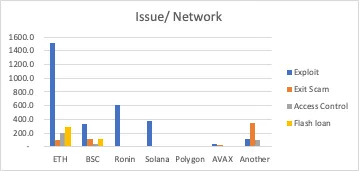
Networks: Losses vs. Case Counts
By losses
 Relationship between issue and network by total losses
- Ethereum accounts for ~48% of total losses (≈ US$2,101M).
- Ronin ranks second by value due to a single outsized event.
- On Ethereum, category shares by value are substantial: exploits ≈51%, access-control ≈59%, and flash-loan ≈72% of the losses within each category across networks.
- Exit scams skew toward other/smaller networks, which account for ~57% of exit-scam losses—evidence that scams often cluster on less-mature chains.
By number of cases
 Relationship between issue and network by number of cases
- Ethereum, BSC, and other/smaller networks lead by count of incidents.
- Within exit scams, BSC becomes more prominent by count, even if not by total value.
Trends over time
Since 2020, incident counts have risen across all categories.
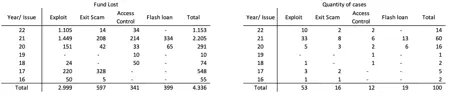
- The snapshot for 2022 may be incomplete if data collection was still underway at the time.
- Exploits gained relative importance by value, while exit scams and access-control remained comparatively flat in value terms.
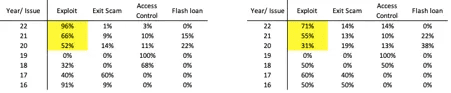
Case studies: The biggest rekt events
- Ronin (≈US$624M). Centralization of validator keys enabled an attacker to gather enough signatures (five validators) to approve fraudulent withdrawals, an acute governance and key-management failure.
- Poly Network. A cross-chain permissioning flaw allowed privileged contracts to relay messages that invoked special-privilege functions. Systems that rely on privileged calls must ensure cross-chain relays cannot access those code paths.
- Wormhole (Solana, Feb 2022). A bridge verification failure led to ETH being treated as deposited on Ethereum, allowing the attacker to mint the corresponding WETH on Solana.
Takeaways
- Decentralization of key management and validator sets is non-negotiable.
- Bridge security and cross-chain permissioning matter as much as on-chain contract safety.
- Treat flash loans as a stress test: if a protocol breaks under them, the issue is in its logic or oracle design.